Computer System Components
14 views
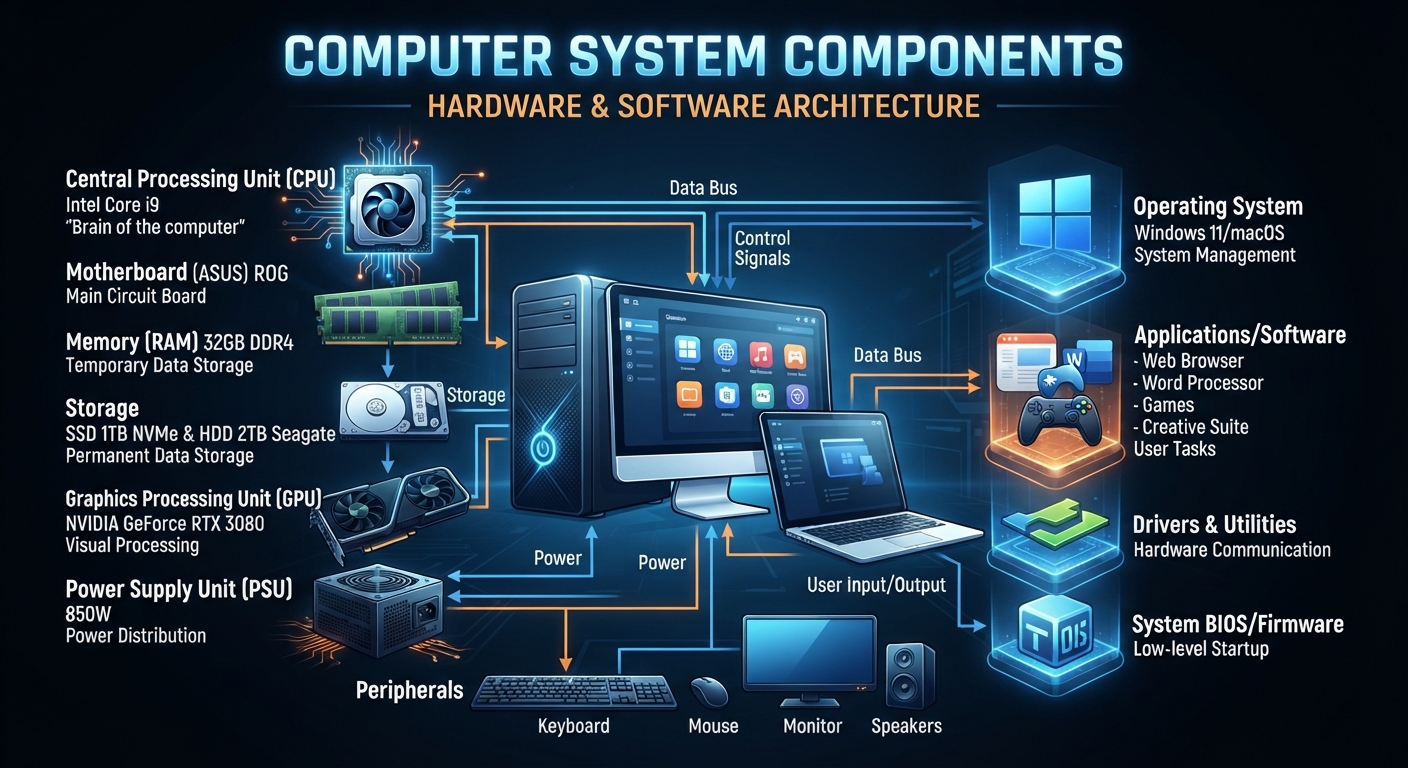
Week 4: Computer System Components (Updated & Expanded)
A computer system can be understood as a functional machine that transforms input data into meaningful output through processing and storage. From a mathematical and computational perspective, a computer system performs operations on sets of data using a controlled sequence of instructions.
A modern computer system consists of four primary functional components:
1. Input Devices (Data Acquisition)
Function: Input devices transmit raw data and control signals into the computer system for processing.
Examples:
- Keyboard (discrete symbol input)
- Mouse / Trackpad (positional input)
- Scanner (image‑to‑digital conversion)
- Webcam (visual data capture)
- Microphone (audio‑to‑signal conversion)
- Touchscreen (combined input + output)
2. Processing Device – CPU
Function: The CPU is the “brain” of the computer. It executes instructions from software by performing:
- Arithmetic operations (+, −, ×, ÷)
- Logical operations (AND, OR, NOT)
- Control operations
- I/O coordination
Mathematical View:
CPU: x → f(x) → y
3. Output Devices (Result Presentation)
Function: Output devices send processed data from the computer to the user or another system.
- Monitor
- Printer
- Speakers
- Projector
4. Storage Devices (Memory Systems)
A. Primary Storage (Volatile – RAM)
CPU ⇄ RAM (Fast, Temporary)
B. Secondary Storage (Non‑Volatile)
RAM → SSD/HDD → RAM
Summary Diagram
Test yourself on Computer Hardware And GSM Repaire
Basic Computer and Phone Troubleshooting Techniques Practice Test
50 questions
15 min
SSS1
Start quiz
Track your reading & take quizzes
Create free account