Quadratic Equations
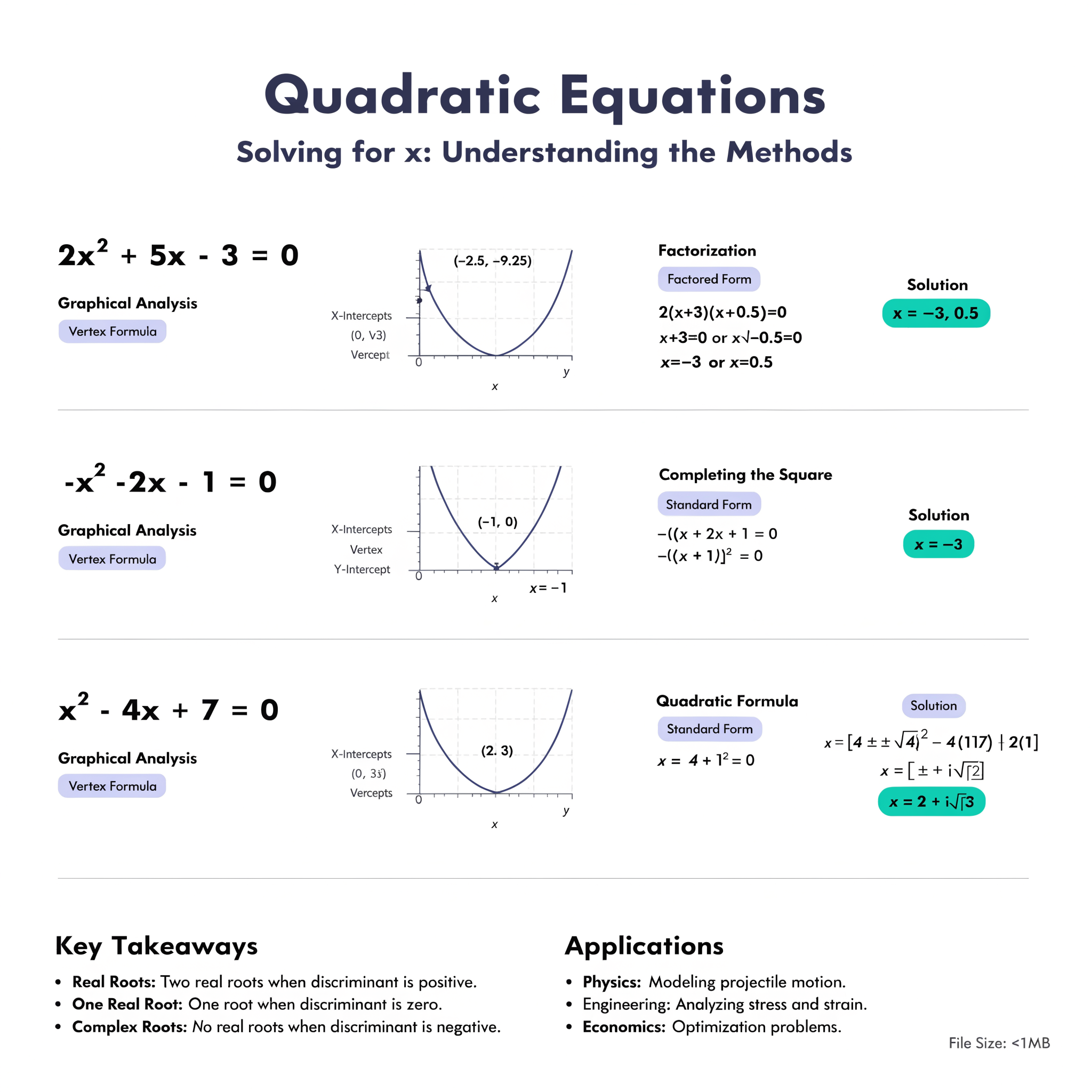
QUADRATIC EQUATIONS
Introduction
A quadratic equation is a polynomial equation in which the highest power (degree) of the unknown variable is 2. It always contains an equal sign (=) and can be written in the general form:
where:
- a, b, c are constants (real numbers)
- a ≠ 0 (if a = 0, the equation becomes linear)
- x is the unknown variable
Examples of Quadratic Equations
| Equation | Reason it is Quadratic |
|---|---|
| 2x2 – 5x – 3 = 0 | Highest power of x is 2 |
| n2 + 50 = 27n | Can be rearranged to n2 – 27n + 50 = 0 |
| (4a – 9)(2a + 1) = 0 | When expanded gives 8a2 – 14a – 9 = 0 |
| k2 = 49 | Can be rewritten as k2 – 49 = 0 |
Answer: When we expand the brackets:
Main Objective
The main goal of this topic is to learn methods of solving quadratic equations — finding the value(s) of the unknown that make the equation true. These values are called the roots or solutions of the equation. A quadratic equation generally has two solutions (which may sometimes be equal).
METHOD 1: SOLVING BY FACTORIZATION
The Zero Product Principle
This method is based on a simple but powerful idea:
Illustrations:
- 3 × 0 = 0 ✓
- 0 × 5 = 0 ✓
- 0 × 0 = 0 ✓
- 7 × 4 = 28 (NOT zero, because neither factor is zero)
In general: If a × b = 0, then either a = 0, or b = 0, or both.
Example 1: Already Factorized Equations
Solve: (x – 2)(x + 7) = 0
Solution: Since the product is zero, one of the factors must be zero:
∴ The roots are x = 2 or x = –7
Example 2: Equation with Three Factors
Solve: d(d – 4)(d + 6) = 0
Solution: Any of the three factors may equal zero:
CLASS EVALUATION
Solve the following equations:
- 3d2(d – 7) = 0
- (6 – n)(4 + n) = 0
- a(2 – a)2(1 + a) = 0
Solving Quadratic Equations Using Factorization (Step-by-Step)
- Rearrange the equation in the form ax2 + bx + c = 0
- Factorize the left-hand side (LHS)
- Equate each factor to zero
- Solve for the unknown
- Check by substituting the values back
Example 1
Solve: 4y2 + 5y – 21 = 0
Solution — Factorize the LHS:
Set each factor to zero:
Check by substitution:
When y = –3: 4(–3)2 + 5(–3) – 21 = 36 – 15 – 21 = 0 ✓
When y = 7/4: 4(7/4)2 + 5(7/4) – 21 = 49/4 + 35/4 – 21 = 21 – 21 = 0 ✓
Example 2: Difference of Two Squares
Solve: m2 = 16
Solution: Rearrange: m2 – 16 = 0
Factorize (difference of two squares):
∴ m = ±4
CLASS EVALUATION
Solve the following quadratic equations:
- h2 – 15h + 54 = 0
- 12y2 + y – 35 = 0
- 4a2 – 15a = 4
- v2 + 2v – 35 = 0
METHOD 2: COMPLETING THE SQUARE
Why Use Completing the Square?
Not all quadratic equations can be easily factorized. The completing the square method works for every quadratic equation.
Key Idea
This method transforms a quadratic expression into a perfect square trinomial plus a constant.
So, to make x2 + bx into a perfect square, we add (b/2)2:
Illustration
| Expression | Add (b/2)2 | Perfect Square |
|---|---|---|
| x2 + 6x | + 9 | (x + 3)2 |
| x2 – 10x | + 25 | (x – 5)2 |
| x2 + 5x | + 25/4 | (x + 5/2)2 |
Steps for Completing the Square
- Arrange the equation in the form ax2 + bx + c = 0
- Divide every term by a (so coefficient of x2 becomes 1)
- Move the constant term to the right-hand side (RHS)
- Add (half the coefficient of x)2 to both sides
- Express the LHS as a perfect square
- Take the square root of both sides
- Solve for the unknown
Example 1
Solve: x2 + 6x – 7 = 0 by completing the square.
Step 1: Move the constant to the RHS:
Step 2: Half of coefficient of x = 6/2 = 3; square it: 32 = 9
Step 3: Add 9 to both sides:
Step 4: Take the square root of both sides:
Step 5: Solve for x:
∴ x = 1 or x = –7
Example 2
Solve: 2x2 – 8x + 5 = 0 by completing the square.
Step 1: Divide through by 2:
Step 2: Move constant to RHS:
Step 3: Half of –4 = –2; (–2)2 = 4. Add 4 to both sides:
Step 4: Take the square root:
Step 5: Solve:
Example 3
Solve: x2 + 5x + 2 = 0 by completing the square.
Move constant:
Half of 5 = 5/2; (5/2)2 = 25/4. Add to both sides:
Take square root:
Since √17 ≈ 4.123:
Geometric Illustration of Completing the Square
To visualize x2 + 6x, imagine a square with side x and a rectangle of length 3 on two sides. Adding a small square of area 9 completes the larger square:
GENERAL EVALUATION
Solve the following equations:
- y2(3 + y) = 0
- x2(x + 5)(x – 5) = 0
- (v – 7)(v – 5)(v – 3) = 0
- 9f2 + 12f + 4 = 0
- x2 + 8x + 3 = 0 (use completing the square)
- 2x2 – 5x – 3 = 0 (use completing the square)
WEEKEND ASSIGNMENT
Section A: Objective Questions
Solve and check by substitution:
- (4b – 12)(b – 5) = 0 A. ½, 4 B. 3, 5 C. 4, 6 D. 5, 3
- (11 – 4x)2 = 0 A. 11, 3 B. 23/4, 3 C. 11/4 twice D. 24/3 twice
- (d – 5)(3d – 2) = 0 A. 5, 2/3 B. 4, 5 C. 5, 9 D. 2, 5
- u2 – 8u – 9 = 0 A. –1, 9 B. 1, 9 C. 1, 8 D. 9, –1
- c2 = 25 A. 5 B. –5 C. +5 D. ±5
Section B: Theory
Solve the following equations:
- 2x2 = 3x + 5
- a2 – 3a = 0
- p2 + 7p + 12 = 0
- x2 – 6x + 4 = 0 (use completing the square)
- 3x2 + 7x – 6 = 0 (use both methods and compare)
SUMMARY
| Method | Best Used When | Advantage |
|---|---|---|
| Factorization | Expression factorizes easily into integers | Quick and direct |
| Completing the Square | Equation does not factorize easily | Works for all quadratics; reveals vertex form |
✅ Always remember: A quadratic equation has at most two solutions (roots).
Test yourself on Mathematics
Track your reading & take quizzes
Create free account