SIMPLE EQUATION AND VARIATIONS
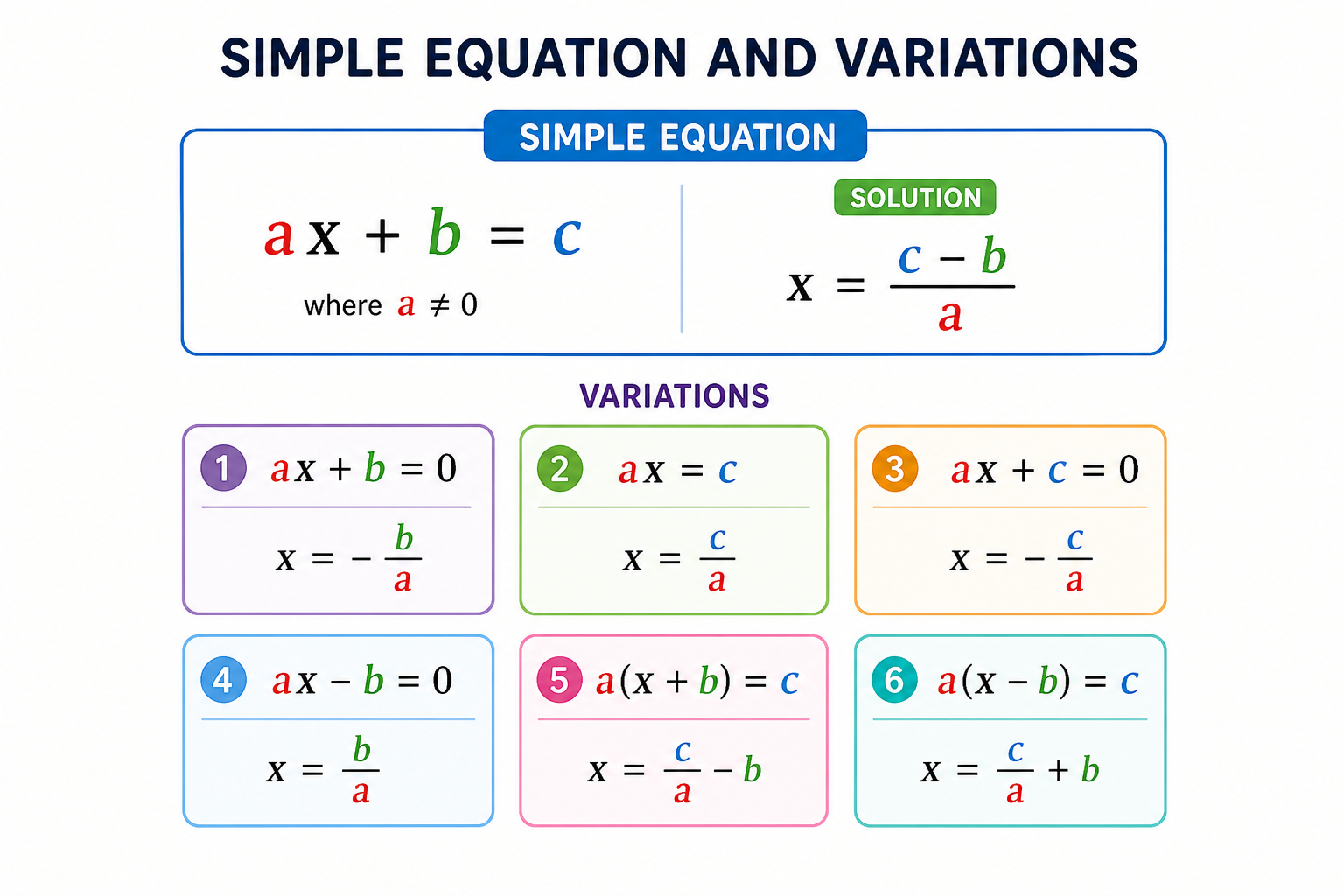
TOPIC: SIMPLE EQUATIONS AND VARIATIONS
Content
- Simple equations
- Change of subject of formulae
- Types of variation:
- Direct variation
- Inverse variation
- Joint variation
- Partial variation
- Applications of variation
1. Simple Equations
Meaning of an Equation
An equation is a mathematical statement showing that two algebraic expressions are equal.
For example:
4 - 4x = 9 - 12x
This is a linear equation in one unknown, x. It is only true for a particular value of x.
To solve an equation means to find the value of the unknown that makes the equation true.
Principle of Solving Equations
When solving equations, we use the balance method.
Think of an equation like a balance scale:
- If the same value is added to both sides, the balance remains equal.
- If the same value is subtracted from both sides, the balance remains equal.
- If both sides are multiplied or divided by the same non-zero number, the balance is still maintained.
Illustration
If x + 3 = 8, then subtracting 3 from both sides gives:
x + 3 - 3 = 8 - 3
x = 5
Example 1
Solve: 4 - 4x = 9 - 12x
Solution
Add 12x to both sides:
4 - 4x + 12x = 9 - 12x + 12x
4 + 8x = 9
Subtract 4 from both sides:
8x = 5
Divide both sides by 8:
x = 5/8
Answer: x = 5/8
Example 2
Solve: 3(4c - 7) - 4(4c - 1) = 0
Solution
Expand the brackets:
12c - 21 - 16c + 4 = 0
Collect like terms:
-4c - 17 = 0
Add 17 to both sides:
-4c = 17
Divide both sides by -4:
c = -17/4
Answer: c = -17/4
More Examples
Example 3: Solve 2 - 5t = 20 - 8t
2 + 3t = 20
3t = 18
t = 6
Example 4: Solve d = 12 - (11 + 4d)
d = 1 - 4d
5d = 1
d = 1/5
Example 5: Solve 21/(3d) = 28
7/d = 28
7 = 28d
d = 1/4
Evaluation
- 2 - 5t = 20 - 8t
- d = 12 - (11 + 4d)
- 21/(3d) = 28
2. Change of Subject of Formulae
A formula shows the relationship between two or more variables. Sometimes, it is necessary to make a different letter the subject of the formula.
Example
In the formula A = πr², if we want r to be the subject:
r = √(A/π)
Steps for Changing the Subject of a Formula
- Treat the formula like an equation.
- Remove fractions, brackets, or roots if necessary.
- Collect all terms containing the required subject on one side.
- Factor out the subject if it appears in more than one term.
- Divide to isolate the subject.
- Simplify your final answer.
Example 1
Make x the subject of a = b(a - x)
a = ba - bx
bx = ba - a
x = (ba - a)/b
x = a(b - 1)/b
Example 2
Make x the subject of a = (b + x)/(b - x)
a(b - x) = b + x
ab - ax = b + x
ab - b = ax + x
ab - b = x(a + 1)
x = (ab - b)/(a + 1)
x = b(a - 1)/(a + 1)
Example 3
Make x the subject of b = 1/2 √(a² - x²)
2b = √(a² - x²)
4b² = a² - x²
x² = a² - 4b²
x = ±√(a² - 4b²)
Evaluation
- x(a - b) = b(c - x)
- √(x² - a²) = b
- (ax - b)(bx + a) = a(bx² + a)
3. Variation
Variation describes how one quantity changes in relation to another quantity.
There are four main types of variation:
- Direct variation
- Inverse variation
- Joint variation
- Partial variation
4. Direct Variation
A variable is said to vary directly as another variable if an increase in one causes a proportional increase in the other.
If y ∝ x, then:
y = kx
Real-Life Illustration
If one exercise book costs ₦200, then:
- 2 books cost ₦400
- 3 books cost ₦600
- 10 books cost ₦2000
Thus, cost varies directly as number of books.
Example 1
If 1 packet of sugar costs x naira, what is the cost of 20 packets?
Cost = 20x
Example 2
If C ∝ n and C = 5 when n = 20, find the formula connecting C and n.
C = kn
5 = 20k
k = 1/4
C = 1/4 n
Example 3
If M ∝ L and M = 6 when L = 2, find the relationship and the value of L when M = 15.
M = kL
6 = 2k
k = 3
M = 3L
15 = 3L
L = 5
Evaluation
If P ∝ Q and P = 4.5 when Q = 12, find:
- The relationship between P and Q
- P when Q = 16
- Q when P = 2.4
5. Inverse Variation
A variable is said to vary inversely as another if an increase in one causes a proportional decrease in the other.
If y ∝ 1/x, then:
y = k/x
Illustration: Equal Sectors in a Circle
A full circle has 360°.
- 5 equal sectors: 360/5 = 72°
- 12 equal sectors: 360/12 = 30°
- 18 equal sectors: 360/18 = 20°
As the number of sectors increases, the angle of each sector decreases.
Example 1
If θ ∝ 1/n and θ = 72 when n = 5, find:
- θ when n = 12
- n when θ = 8
θ = k/n
72 = k/5
k = 360
θ = 360/n
θ = 360/12 = 30°
n = 360/8 = 45
Evaluation
- Write a formula for l in terms of A and b if a rectangle has constant area.
- Write a formula for b in terms of A and l.
- State whether l varies directly or inversely with b.
6. Joint Variation
A quantity is said to vary jointly as two or more other quantities when it depends on all of them at the same time.
If M ∝ At, then:
M = kAt
Real-Life Illustration
The mass of a metal sheet depends on its:
- Area
- Thickness
Thus, mass varies jointly as area and thickness.
Example
If Y ∝ 1/X² and X ∝ Z², find the relationship between Y and Z.
Y = A/X² and X = BZ²
Y = A/(BZ²)²
Y = A/(B²Z⁴)
Y = C/Z⁴
Thus, Y ∝ 1/Z⁴
7. Partial Variation
In partial variation, one part of a quantity is constant, while the other part varies with another quantity.
If R is partly constant and partly varies as E, then:
R = c + kE
Real-Life Illustration
The total cost of sewing a dress may include:
- A fixed charge for materials or service
- An additional charge depending on time spent
Example 1
R is partly constant and partly varies with E. When R = 530, E = 1600, and when R = 730, E = 3600.
R = c + kE
530 = c + 1600k
730 = c + 3600k
200 = 2000k
k = 1/10
530 = c + 160
c = 370
R = 370 + E/10
If E = 1300, then:
R = 370 + 130 = 500
Example 2
The cost C of a car service is partly constant and partly varies with time T.
If C = 3500 when T = 5.5 and C = 2900 when T = 4:
C = a + kT
3500 = a + 5.5k
2900 = a + 4k
600 = 1.5k
k = 400
2900 = a + 1600
a = 1300
C = 1300 + 400T
For T = 7.5:
C = 1300 + 400(7.5) = 4300
Evaluation
-
The cost of a car service is partly constant and partly varies with time T.
It costs ₦3,500 for a 5½-hour service and ₦2,900 for a 4-hour service.
- Find the formula connecting C and T.
- Hence find the cost of a 7½-hour service.
-
x is partly constant and partly varies as y.
When y = 2, x = 30,
and when y = 6, x = 50.
- Find the relationship between x and y.
- Find x when y = 3.
8. Applications of Variation
Variation is used in many areas of life and science, such as:
- Commerce: cost of goods varies directly with quantity bought.
- Transport: time varies inversely with speed for a fixed distance.
- Construction: mass of materials may vary jointly with dimensions.
- Tailoring and repairs: total charges may be partly fixed and partly depend on time spent.
- Electricity and physics: many physical quantities depend on direct, inverse, or joint variation.
9. Summary of Formulae
Direct Variation: y = kx
Inverse Variation: y = k/x
Joint Variation: y = kxz
Partial Variation: y = a + kx
10. General Evaluation
- If a man cycles 15 km in 1 hour, how far will he cycle in 2 hours if he keeps the same rate?
- A piece of string is cut into n equal pieces of length l. Does n vary directly or inversely with l?
- The mass of rice each woman gets when sharing a sack varies inversely with the number of women. When there are 20 women, each gets 6 kg of rice. If there are 9 women, how much rice does each woman get?
11. Teacher’s Note / Classroom Illustration Ideas
- For Equations: Use a balance scale drawing to show equality.
- For Direct Variation: Use number of oranges and total cost.
- For Inverse Variation: Use sharing of food among people or speed and time.
- For Joint Variation: Use volume of a box depending on length, breadth, and height.
- For Partial Variation: Use taxi fare = fixed charge + charge per kilometre.
Test yourself on Mathematics
Track your reading & take quizzes
Create free account