LOGARITHMS (Continued)
LOGARITHMS (cont’d)
1. Relationship between Indices and Logarithms
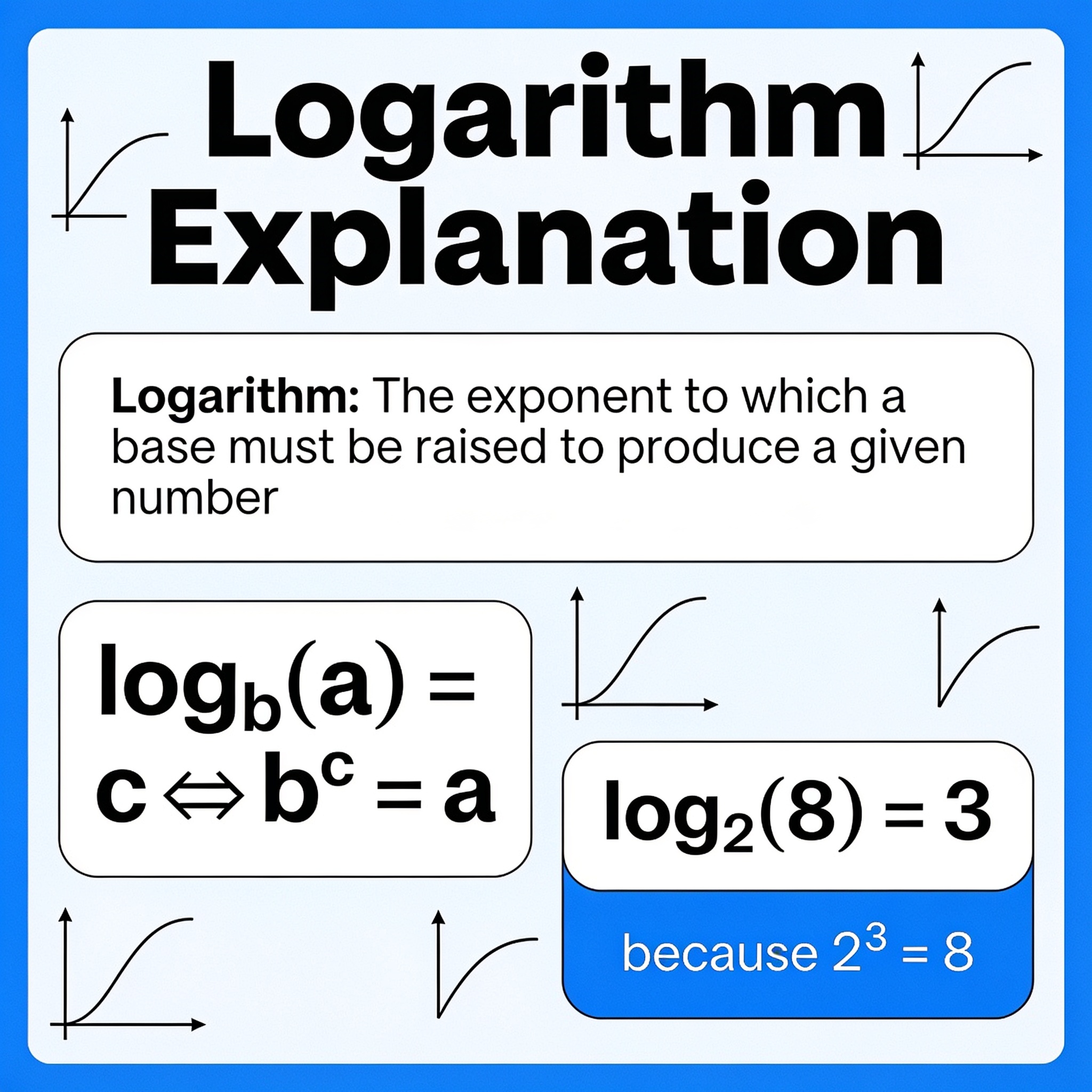
A logarithm is simply another name for an exponent or power. The two concepts are directly related.
📌 Core idea: If you can write a number as a power of another number, you can also express it as a logarithm.
1000 = 103 → log₁₀ 1000 = 3
Table: Numbers as powers of 10
| Number | Power of 10 | Logarithm (base 10) |
|---|---|---|
| 1000 | 10³ | log 1000 = 3 |
| 100 | 10² | log 100 = 2 |
| 10 | 10¹ | log 10 = 1 |
| 1 | 10⁰ | log 1 = 0 |
| 0.1 | 10⁻¹ | log 0.1 = –1 |
| 0.01 | 10⁻² | log 0.01 = –2 |
| 0.001 | 10⁻³ | log 0.001 = –3 |
General rule: If y = nx, then x = logn y. A logarithm answers: “To what power must the base be raised to get this number?”
Example with base 2: Since 32 = 25, then log₂ 32 = 5.
2. Converting Between Index and Logarithmic Forms
Any statement in index (exponential) form can be rewritten in logarithmic form – and vice versa.
▸ Index → Logarithmic
| Index form | Logarithmic form |
|---|---|
| 2⁻³ = ⅛ | log₂(⅛) = –3 |
| 3⁶ = 729 | log₃ 729 = 6 |
| 4³ = 256 | log₄ 256 = 3 |
▸ Logarithmic → Index
| Logarithmic form | Index (exponential) form |
|---|---|
| log₁₀(1/1000) = –3 | 10⁻³ = 1/1000 |
| log₂ 64 = 6 | 2⁶ = 64 |
| log₅(1/125) = –3 | 5⁻³ = 1/125 |
Example 1: Express in logarithmic form:
a) 2⁻³ = ⅛ → log₂(⅛) = –3
b) 3⁶ = 729 → log₃ 729 = 6
c) 4³ = 256 → log₄ 256 = 3
Example 2: Express in index form:
a) log₁₀(1/1000) = –3 → 10⁻³ = 1/1000
b) log₂ 64 = 6 → 2⁶ = 64
c) log₅(1/125) = –3 → 5⁻³ = 1/125
📝 Evaluation
- Given that log₃ 81 = m, then 3m = 81. What is m?
- Find the value of log₂ 128.
- Fill in the blank box: log ⬜ 343 = 3
Show answers
1) 3⁴ = 81 → m = 4. 2) 2⁷ = 128 → log₂ 128 = 7. 3) 7³ = 343 → base = 7.
3. Calculating Powers and Roots Using Logarithm Tables
When using logarithm tables for powers and roots:
- For powers: multiply the logarithm of the number by the power.
- For roots: divide the logarithm of the number by the root index.
Example 1: 252.82
| Number | Log | Operation |
|---|---|---|
| 25 | 1.3979 | × 2.82 |
| Result | 3.9421 | antilog → 8750 |
✅ 252.82 ≈ 8750
Example 2: ⁶√35.81
| Number | Log | Operation |
|---|---|---|
| 35.81 | 1.5540 | ÷ 6 |
| Result | 0.2590 | antilog → 1.816 |
✅ ⁶√35.81 ≈ 1.816
Example 3: √26.21
| Number | Log | Operation |
|---|---|---|
| 26.21 | 1.4185 | ÷ 2 |
| Result | 0.7093 | antilog → 5.121 |
✅ √26.21 ≈ 5.121
1) 3.53³ 2) ⁴√400
4. Calculations Involving Multiplication, Division, Powers & Roots
When multiple operations appear, handle numerator and denominator separately using logs, then subtract.
Example A: (√94100 × 38.2) / (5.683 × 8.14)
| Step | Value | Log | Operation |
|---|---|---|---|
| 1 | √94100 | 4.9736 ÷ 2 = 2.4868 | |
| 2 | 38.2 | 1.5821 | + |
| Numerator | 4.0689 | ||
| 3 | 5.683 | 0.7540 × 3 = 2.2620 | |
| 4 | 8.14 | 0.9106 | + |
| Denominator | 3.1726 | ||
| 5 | Subtract | 4.0689 – 3.1726 = 0.8963 | antilog → 7.878 |
✅ Result ≈ 7.88 (3 s.f.)
Example B: ∛(19.63 × 12.28² × 74)
| Step | Value | Log | Operation |
|---|---|---|---|
| 1 | 19.63 | 1.2930 | |
| 2 | 12.28² | 1.0890 × 2 = 2.1780 | + |
| 3 | 74 | 1.8692 | + |
| Total | 5.3402 | ÷ 3 | |
| 4 | Result log | 1.7801 | antilog → 60.29 |
✅ ≈ 60.3 (3 s.f.)
Example C: ∛( (218 × 37.2) / 95.43 )
| Step | Value | Log | Operation |
|---|---|---|---|
| 1 | 218 | 2.3385 | |
| 2 | 37.2 | 1.5705 | + |
| Numerator | 3.9090 | ||
| 3 | 95.43 | 1.9797 | – (subtract) |
| Difference | 1.9293 | ÷ 3 | |
| 4 | Final log | 0.6431 | antilog → 4.397 |
✅ ≈ 4.40 (3 s.f.)
Example D: ∛( (38.32 × 2.964) / (8.637 × 6.285) )²
| Step | Value | Log | Operation |
|---|---|---|---|
| 1 | 38.32 | 1.5835 | |
| 2 | 2.964 | 0.4718 | + |
| Numerator | 2.0553 | ||
| 3 | 8.637 | 0.9364 | |
| 4 | 6.285 | 0.7983 | + |
| Denominator | 1.7347 | ||
| 5 | Subtract | 2.0553 – 1.7347 = 0.3206 | × 2 |
| 6 | After square | 0.6412 | ÷ 3 |
| 7 | Final log | 0.2137 | antilog → 1.636 |
✅ ≈ 1.636
5. Evaluation Exercises
Use logarithm tables (or calculator) to evaluate correct to 3 s.f. where needed:
- 3.53³
- ⁴√400
- ∛(1064 / 29.4)
- ( (403.9 × 5.78) / (70.62 × 2.931) )²
6. General Evaluation
- If log₅ 0.04 = m and 5m = 0.04, find m.
- Using logarithm tables, evaluate:
a) (35.61)² × 5.62 / ∛143.5
b) ∛(634.6² / 21.5)
Logarithms · updated with details & illustrations
Test yourself on Mathematics
Track your reading & take quizzes
Create free account