Logarithms of Numbers to Base 10
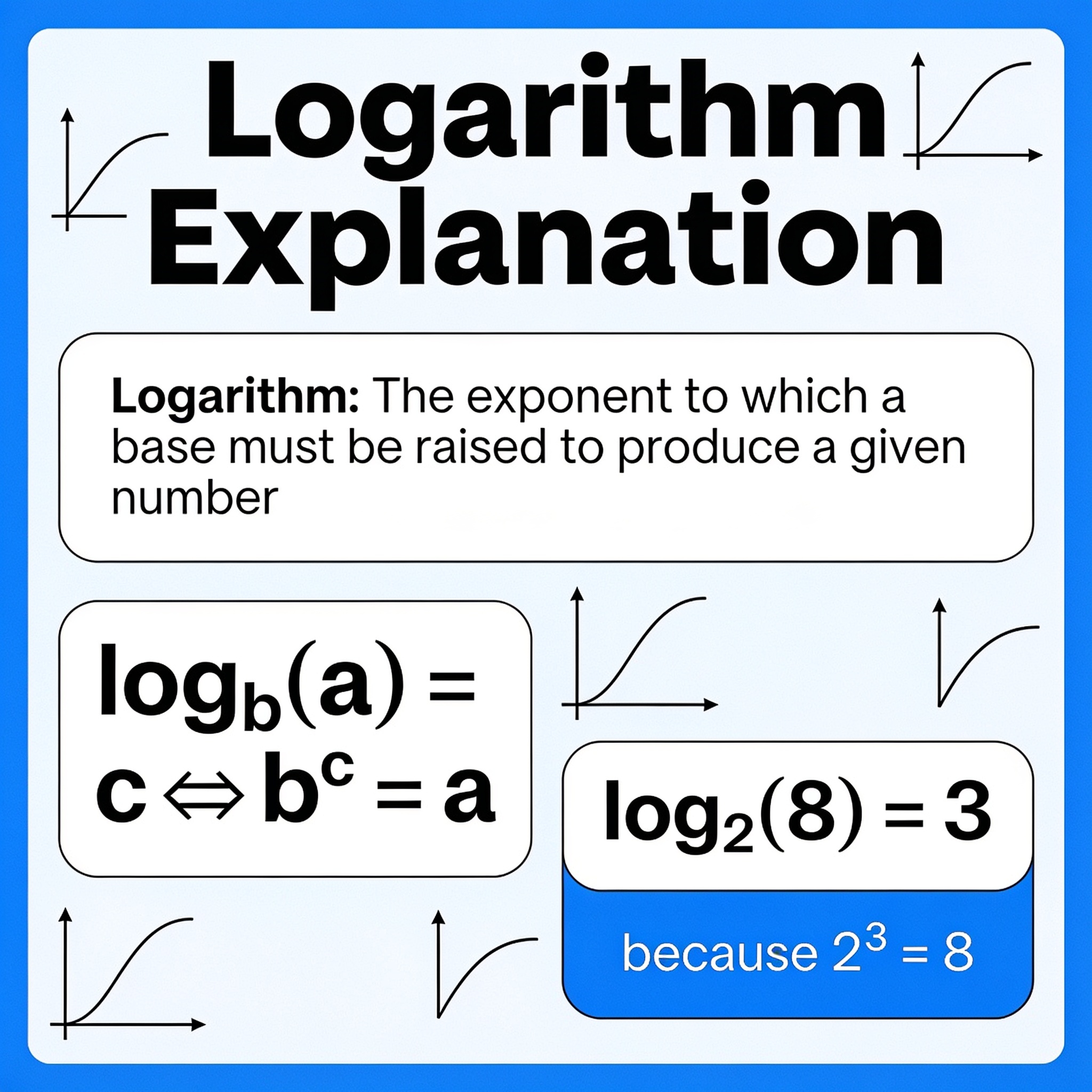
MATHEMATICS LESSON PLAN
OBJECTIVES OF THE LESSON
By the end of this weekly module, students will be able to:
- Define a logarithm and convert statements between Index Form and Logarithmic Form.
- Identify the two distinct parts of a base-10 logarithm: the Characteristic and the Mantissa.
- Determine the common logarithm of numbers greater than, equal to, and less than 1 using 4-figure tables.
- Perform the inverse mathematical operation using Antilogarithm tables.
- Apply the logarithmic laws of multiplication and division to compute complex numerical products and quotients.
1. THE FUNDAMENTAL CONCEPT OF LOGARITHMS
Mathematically: If bx = y, then logb(y) = x.
Therefore, the logarithm of a number to Base 10 is the specific power to which 10 must be raised to produce that number. For example, log10(1000) = 3 because 103 = 1000.
Visual Mapping: Index Form vs. Logarithmic Form
bx = y
logb(y) = x
Worked Examples: Conversions
Example 1: Express the following in Logarithmic Form
➔ log2(1/64) = -6
➔ log3(243) = 5
➔ log5(125) = 3
➔ log10(10000) = 4
Example 2: Express the following in Index Form
➔ 2-3 = 1/8
➔ 10-2 = 1/100
➔ 43 = 64
➔ 54 = 625
2. LOGARITHMS OF NUMBERS TO BASE 10
Every common logarithm consists of two distinct parts separated by a decimal point:
Example: In log10(3900) = 3.5911, the Characteristic is 3, and the Mantissa is .5911
Rules for Finding the Characteristic
- For numbers ≥ 1: Count the number of digits to the left of the decimal point and subtract 1. (e.g., 51.38 has 2 digits before the decimal; 2 - 1 = 1).
- For numbers < 1 (Decimals): Write the number in standard form (A × 10-n). The characteristic is negative n, written in Bar Notation as . (e.g., 0.009321 → 9.321 × 10⁻³; Characteristic = ).
Using the 4-Figure Logarithm Table (Finding the Mantissa)
To find the mantissa of 37, look down the left-hand margin for 37, and slide across to the column headed by 0:
| x | 0 | 1 | 2 | ... | 7 | 8 | 9 |
|---|---|---|---|---|---|---|---|
| 35 | 5441 | 5453 | 5465 | ... | 5527 | 5539 | 5551 |
| 36 | 5563 | 5575 | 5587 | ... | 5647 | 5658 | 5670 |
| 37 | 5682 | 5694 | 5705 | ... | 5763 | 5775 | 5786 |
Putting it together:
- For 37: Characteristic is 1. Mantissa is .5682 → log10(37) = 1.5682
- For 3900: Characteristic is 3. Mantissa of 39 under 0 is .5911 → log10(3900) = 3.5911
3. ANTILOGARITHMS
An Antilogarithm is the exact inverse of a logarithm. When finding an antilogarithm:
- Look up only the fractional mantissa part inside the Antilogarithm table to get your raw sequence of digits.
- Use the integer Characteristic to place the decimal point: Shift the decimal point (Characteristic + 1) places to the right.
| Given Logarithm | Mantissa Lookup | Characteristic shift | Final Antilog Number |
|---|---|---|---|
| 0.5682 | .56 under 8, diff 2 → 3700 |
0 + 1 = 1 digit | 3.700 |
| 2.7547 | .75 under 4, diff 7 → 5684 |
2 + 1 = 3 digits | 568.4 |
| .7652 | .76 under 5, diff 2 → 5824 |
Negative 2 → insert 1 zero | 0.05824 |
4. MULTIPLICATION AND DIVISION USING TABLES
We use the standard Laws of Logarithms to turn multi-digit arithmetic into basic addition and subtraction:
Quotient Law: log(A ÷ B) = log A − log B
Worked Layouts
1. Evaluate: 4627 × 29.3
| Number | Logarithm |
|---|---|
| 4627 | 3.6653 |
| × 29.3 | + 1.4669 |
| Antilog: 135,600 | 5.1322 |
2. Evaluate: 819.8 ÷ 3.905
| Number | Logarithm |
|---|---|
| 819.8 | 2.9137 |
| ÷ 3.905 | − 0.5916 |
| Antilog: 209.9 | 2.3221 |
3. Evaluate combined operation: (48.63 × 8.53) ÷ (15.39 × 3.52)
| Operation Step | Number | Logarithm |
|---|---|---|
| Numerator | 48.63 8.53 | 1.6869 + 0.9309 |
| Numerator Sum (A) | 2.6178 | |
| Denominator | 15.39 3.52 | 1.1872 + 0.5465 |
| Denominator Sum (B) | 1.7337 | |
| Subtract: (A) − (B) | 0.8841 | |
| Final Antilog Answer | 7.658 | |
CLASS EVALUATION
- Find the logarithm of: (i) 0.009321 (ii) 0.5454
- Find the antilogarithm of: (i) 3.3210 (ii) 1.8113 (iii) .5813 (iv) 0.2212
- Use logarithm tables to evaluate: (36.12 × 750.9) ÷ (113.2 × 9.98)
READING ASSIGNMENT
New General Mathematics SSS1 — Read Page 21, complete Exercise 1h (Problems 1 – 3).
WEEKEND ASSIGNMENT
Part A: Multiple Choice Questions
- Find the log of 802 to base 10 (use log tables):
(a) 2.9042 (b) 3.9040 (c) 8.020 (d) 1.9042 - Find the number whose logarithm is 2.8321:
(a) 6719.2 (b) 679.4 (c) 0.4620 (d) 67.92 - What is the integer characteristic of the log of 0.000352?:
(a) (b) (c) 4 (d) 3 - Given that log2(1/64) = m, what is m?:
(a) -5 (b) -4 (c) -6 (d) 3 - Express in index form: log10(10000) = 4:
(a) 103 = 10000 (b) 10-4 = 10000 (c) 104 = 10000
Part B: Theory Questions
- Evaluate using a logarithm table: (6.28 × 304) ÷ 981.
Express your final answer in the standard form A × 10n. - Use a logarithm table to calculate correct to 3 significant figures: (6354 × 6.243) ÷ (16.76 × 323)
🔒 CLICK TO REVEAL TEACHER'S ANSWER KEY
Class Evaluation Answers:
1(i) .9695 | 1(ii) .7367
2(i) 2094 | 2(ii) 64.76 | 2(iii) 0.3813 | 2(iv) 1.664
3. Numerator Log sum (4.4332) − Denominator Log sum (3.0530) = 1.3802 → Antilog = 23.99
Weekend Assignment (Part A - MCQ):
1. (a) 2.9042
2. (b) 679.4
3. (a)
4. (c) -6
5. (c) 104 = 10000
Weekend Assignment (Part B - Theory Solutions):
Theory 1: Num Logs: 0.7980 + 2.4829 = 3.2809. Den Log: 2.9917.
Difference 3.2809 − 2.9917 = 0.2892. Antilog = 1.946 → Standard Form: 1.946 × 100
Theory 2: Num Logs Sum = 4.5984. Den Logs Sum = 3.7335.
Difference = 0.8649. Antilog = 7.3265 → Correct to 3 s.f. = 7.33
Test yourself on Mathematics
Track your reading & take quizzes
Create free account