Indices
INDICES (EXPONENTS)
📋 Table of Contents
📖 Introduction
In mathematics, indices (singular: index), also known as exponents or powers, provide a shorthand way of expressing repeated multiplication of a number by itself.
For example:
Here, 2 is called the base and 5 is called the index (or exponent). The expression 25 is read as "2 raised to the power of 5."
xn = x × x × x × ··· × x (n times)
where x = base, n = index
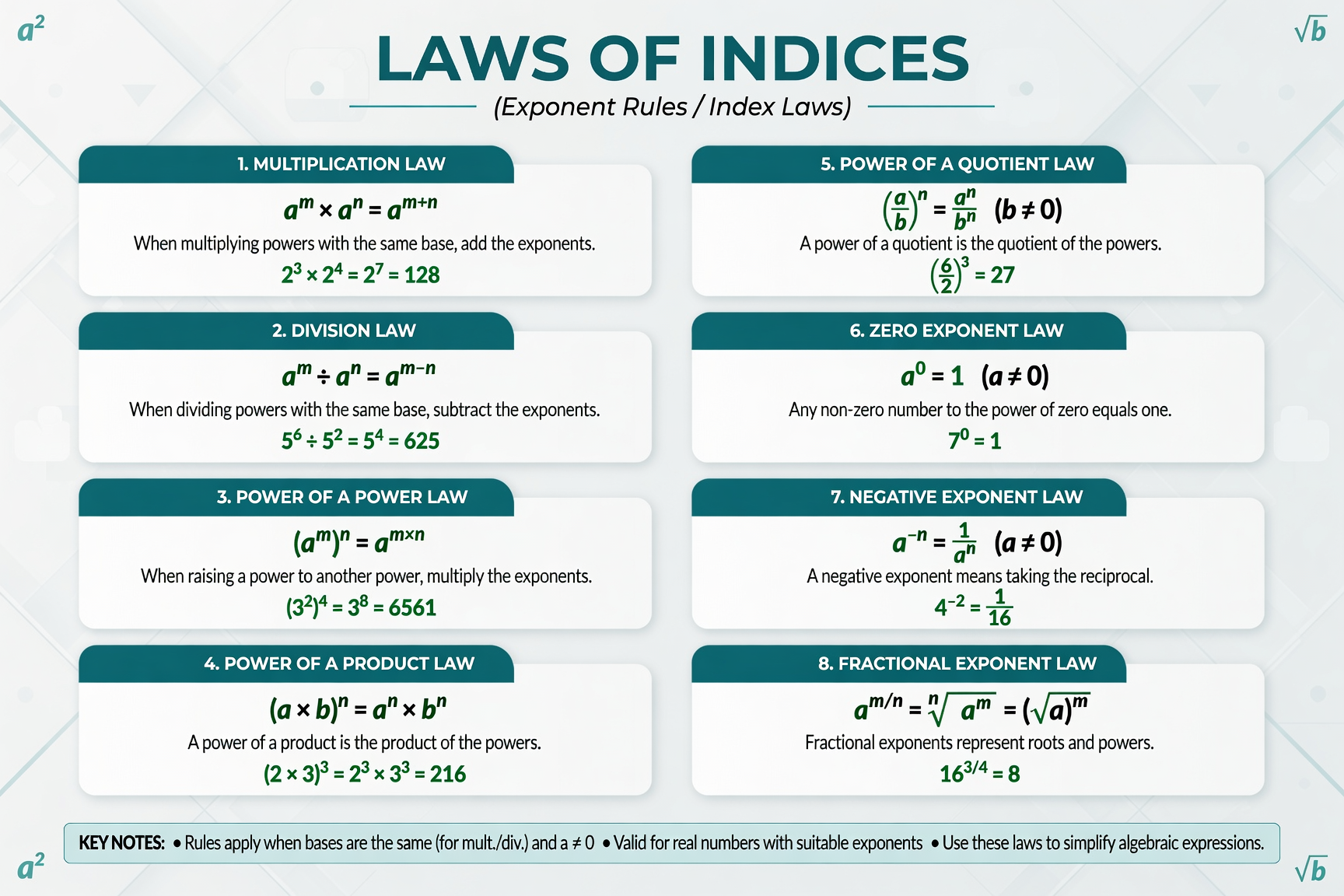
The laws of indices are rules that govern how expressions involving powers can be simplified. These laws hold for all values of the base x ≠ 0, and for all real values of the indices a and b.
When multiplying two powers that have the same base, add the indices.
x3 × x2 = (x × x × x) × (x × x) = x3+2 = x5
When dividing two powers that have the same base, subtract the index of the denominator from the index of the numerator.
x5x2 = x × x × x × x × xx × x = x5−2 = x3
Any non-zero number raised to the power of zero equals 1.
But we also know that any number divided by itself equals 1:
Therefore: x0 = 1
A negative index indicates the reciprocal of the base raised to the corresponding positive index.
✏️ Worked Examples — Laws 1 to 4
Simplify each of the following:
- 105 × 104
- a3 × a4
- m8 ÷ m5
- 24x6 ÷ 8x4
- 198 ÷ 198
📝 Evaluation — Practice Questions (Laws 1 to 4)
Simplify each of the following:
- 6 × z0
- 4−3
- z3 × (⅙)1
- r × r × r × r−5
Click to reveal answers
(a) 6 × z0 = 6 × 1 = 6
(b) 4−3 = 143 = 164 = 1/64
(c) z3 × 16 = z36
(d) r × r × r × r−5 = r1+1+1+(−5) = r3−5 = r−2 = 1r2
When a power is raised to another power, multiply the indices.
(x2)3 = x2 × x2 × x2 = x2+2+2 = x2×3 = x6
When a product of bases is raised to a power, the power applies to each factor separately.
(2x)3 = 23 × x3 = 8x3
When a fraction is raised to a power, the power applies to both the numerator and the denominator.
(34)2 = 3242 = 916
📊 Summary Table of All Laws of Indices
| Law | Rule | Name |
|---|---|---|
| 1st | xa × xb = xa+b | Multiplication Law |
| 2nd | xa ÷ xb = xa−b | Division Law |
| 3rd | x0 = 1 | Zero Index Law |
| 4th | x−a = 1/xa | Negative Index Law |
| 5th | (xa)b = xab | Power of a Power |
| 6th | (xy)a = xaya | Power of a Product |
| 7th | (x/y)a = xa/ya | Power of a Quotient |
✏️ Worked Examples — Power of a Power
Simplify each of the following:
- (x2)3
- (y4)2
- (3−2)−3
- (−3d3)2
- a6 · (−a)−4
(Even power of a negative base gives a positive result.)
Therefore:📝 Evaluation — Practice Questions (Power of a Power)
Simplify each of the following:
- (h4)−5
- (−4u2v)3
- (−x3)2 ÷ x4
- −(d2) ÷ d4 × (−d)
- (−c)2 × c4 ÷ (−c3)
Click to reveal answers
1. (h4)−5 = h4×(−5) = h−20 = 1h20
2. (−4u2v)3 = (−4)3 × (u2)3 × v3 = −64 × u6 × v3 = −64u6v3
3. (−x3)2 ÷ x4 = (−1)2 · x6 ÷ x4 = x6 ÷ x4 = x6−4 = x2
4. −d2 ÷ d4 × (−d) = −d2−4 × (−d) = −d−2 × (−d) = d−2+1 = d−1 = 1d
5. (−c)2 × c4 ÷ (−c3) = c2 × c4 ÷ (−c3) = c6−c3 = −c6−3 = −c3
Fractional indices involve exponents that are fractions. They are closely related to roots (square roots, cube roots, etc.).
Understanding x1/n — The nth Root
Square Root
The square root of x, written √x, is the number which when multiplied by itself gives x:
Let √x = xp. Then:
x2p = x1
Equating the indices: 2p = 1 ⟹ p = ½
Cube Root
The cube root of x, written ∛x, is the number which when multiplied by itself three times gives x:
Let ∛x = xq. Then:
x3q = x1
Equating the indices: 3q = 1 ⟹ q = ⅓
• ∛8 = 81/3 = 2 since 2 × 2 × 2 = 8
• ∛(−27) = (−27)1/3 = −3 since (−3) × (−3) × (−3) = −27
General nth Root
The fractional index 1/n means "take the nth root" of the base.
| Expression | Meaning | Value |
|---|---|---|
| 161/2 | √16 | 4 |
| 271/3 | ∛27 | 3 |
| 811/4 | 4√81 | 3 |
| 321/5 | 5√32 | 2 |
Understanding xa/b — General Fractional Index
A fractional index a/b can be interpreted in two equivalent ways:
- Root first, then power: Take the bth root of x, then raise the result to the power a.
- Power first, then root: Raise x to the power a, then take the bth root.
82/3 = (∛8)2 = (2)2 = 4
OR equivalently:
82/3 = ∛(82) = ∛64 = 4
✏️ Worked Examples — Fractional Indices
Simplify each of the following:
- 8−2/3
- 41/6 × 41/3
- (16/81)−3/4
- √(72a3b−2 / 2a5b−6)
4√16 = 2 (since 24 = 16)
Divide the coefficients: 72 ÷ 2 = 36
Apply the second law to each variable:
b−2−(−6) = b−2+6 = b4
📝 Evaluation — Practice Questions (Fractional Indices)
Simplify each of the following:
- (125)−1/3
- (18/32)−3/2
- (∛4)1.5
- 64−5/6
- √(1 9/16)
Click to reveal answers
1. 125−1/3 = 11251/3 = 1∛125 = 15 = 1/5 (since 5 × 5 × 5 = 125)
2. (18/32)−3/2
First simplify: 18/32 = 9/16
(9/16)−3/2 = (16/9)3/2 = (√(16/9))3 = (4/3)3
= 64/27
3. (∛4)1.5 = (41/3)3/2 = 4(1/3)×(3/2) = 41/2 = √4 = 2
4. 64−5/6 = 1645/6 = 1(6√64)5 = 125 = 1/32 (since 26 = 64)
5. √(1 9/16) = √(25/16) = √25√16 = 5/4
To solve equations involving indices, we use the following key strategies:
🎯 Key Strategies:
- Strategy 1: If xa = xb (same base), then a = b (equate the indices).
- Strategy 2: Express both sides of the equation with the same base, then equate the indices.
- Strategy 3: Use the laws of indices to simplify, then solve.
- Strategy 4: Raise both sides to an appropriate power to eliminate fractional indices.
✏️ Worked Examples — Solving Equations
Solve the following equations:
- 2r−3 = −16
- 5x ÷ 5 = 40x−1/2 ÷ 5
- 4c−1 = 64
r3 = 1−8 = −18
2(−½)−3 = 2 × 1(−½)3 = 2 × 1−⅛ = 2 × (−8) = −16 ✓
x3/2 = 8
x(3/2)×(2/3) = 82/3
x1 = (∛8)2 = (2)2 = 4
LHS = 5(4) ÷ 5 = 4
RHS = 40(4)−1/2 ÷ 5 = 40 × ½ ÷ 5 = 20 ÷ 5 = 4 ✓
Since 4 = 4 and 64 = 43:
📝 Evaluation — Practice Questions (Solving Equations)
Solve the following equations:
- a2/3 = 9
- 2x3 = 54
Click to reveal answers
1. a2/3 = 9
Raise both sides to the power 3/2:
a = 93/2 = (√9)3 = 33 = 27
2. 2x3 = 54
Divide both sides by 2: x3 = 27
Take the cube root: x = ∛27 = 3
Solve or simplify the following:
Question 1
If 92x+13x = 81x−2, find x.
2 + 8 = 4x − 3x
x = 10
Question 2
Solve: 9x−1 = 27x+1
−2 − 3 = 3x − 2x
x = −5
Question 3
Simplify: ∛(72p−3q−79p9q5)
Divide the coefficients: 72 ÷ 9 = 8
Apply the second law to each variable:
q−7−5 = q−12
| Concept | Formula / Rule |
|---|---|
| Multiplication (same base) | xa × xb = xa+b |
| Division (same base) | xa ÷ xb = xa−b |
| Zero index | x0 = 1 |
| Negative index | x−a = 1/xa |
| Power of a power | (xa)b = xab |
| Power of a product | (xy)a = xaya |
| Fractional index (root) | x1/n = n√x |
| General fractional index | xa/b = (b√x)a |
| Solving: same base | If xa = xb, then a = b |
Test yourself on Mathematics
Track your reading & take quizzes
Create free account