Standard Form And Approximation
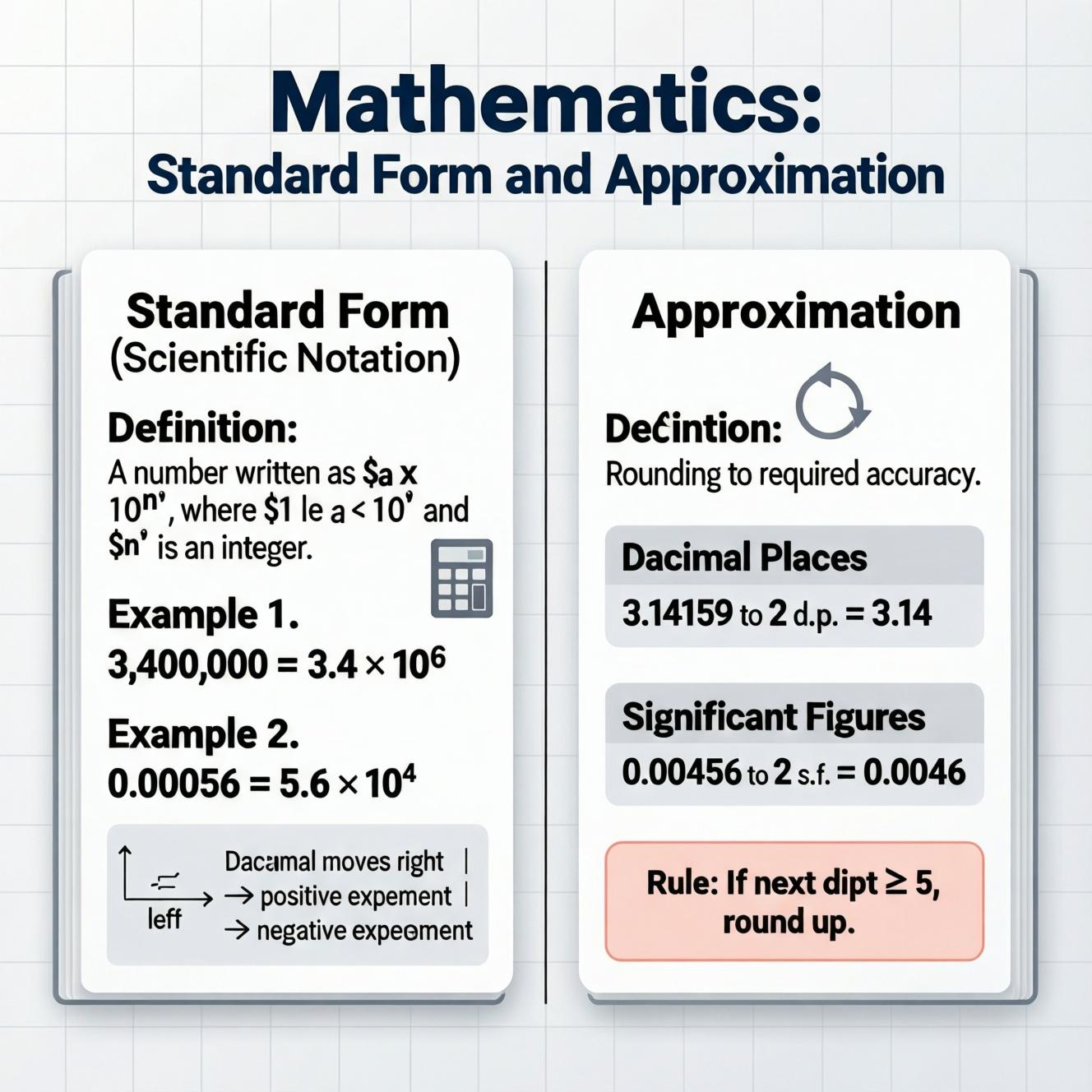
WEEK FIVE
Topic: Revision of Standard Form and Approximation
Content
- Revision of Standard Form
- Rounding Off Numbers
- Decimal Places
- Significant Figures
Learning Objectives
By the end of this lesson, students should be able to:
- Write large and small numbers in standard form.
- Change numbers from standard form to ordinary form.
- Round numbers to the nearest ten, hundred, and thousand.
- Round numbers to a given number of decimal places.
- Round numbers to a given number of significant figures.
- Distinguish between decimal places and significant figures.
1. Revision of Standard Form
Meaning of Standard Form
A number is said to be in standard form when it is written as:
A × 10n
where:
- 1 ≤ A < 10
- n is an integer (positive, negative, or zero)
Standard form is also called scientific notation. It is useful for writing very large or very small numbers in a short and neat way.
Examples
- 2 × 10⁶
- 7 × 10⁻³
- 2.5 × 10⁴
- 8.6 × 10⁻⁹
Important Idea
- If the number is greater than 10, the power of 10 is usually positive.
- If the number is between 0 and 1, the power of 10 is usually negative.
Illustration with Powers of 10
| Power of 10 | Ordinary Form |
|---|---|
| 101 | 10 |
| 102 | 100 |
| 103 | 1,000 |
| 104 | 10,000 |
| 10-1 | 0.1 |
| 10-2 | 0.01 |
| 10-3 | 0.001 |
| 10-4 | 0.0001 |
How to Write a Number in Standard Form
- Move the decimal point until only one non-zero digit remains to the left of the decimal point.
- Count how many places the decimal point moves.
- If it moves to the left, the exponent is positive.
- If it moves to the right, the exponent is negative.
Worked Example 1: Express the following numbers in standard form
-
300,000
300,000 = 3 × 10⁵
Decimal point moved 5 places to the left. -
55
55 = 5.5 × 101 -
2,300,000
2,300,000 = 2.3 × 10⁶ -
720,000,000
720,000,000 = 7.2 × 10⁸ -
9,400,000,000
9,400,000,000 = 9.4 × 10⁹
Worked Example 2: Change from standard form to ordinary form
Rule: For a positive power, move the decimal point to the right. For a negative power, move it to the left.
- 5.1 × 107 = 51,000,000
- 2.5 × 106 = 2,500,000
- 3.4 × 101 = 34
- 9.8 × 105 = 980,000
- 6 × 108 = 600,000,000
Worked Example 3: Express the following decimal fractions in standard form
- 0.0015 = 1.5 × 10⁻³
- 0.000026 = 2.6 × 10⁻⁵
- 0.000000067 = 6.7 × 10⁻⁸
- 0.3 = 3 × 10⁻¹
Worked Example 4: Express the following as decimal fractions
- 9.4 × 10-5 = 0.000094
- 8.8 × 10-3 = 0.0088
- 1.8 × 10-1 = 0.18
- 2 × 10-7 = 0.0000002
Examples:
- 0.5 = 5 × 10⁻¹
- 0.04 = 4 × 10⁻²
- 0.007 = 7 × 10⁻³
Quick Practice
- Change to ordinary form:
- 9.18 × 10⁵
- 6.75 × 10⁻⁸
- Express in standard form:
- 0.0000058
- 458,000
2. Approximation
Approximation means giving a value that is close to the exact value.
We use approximation when:
- the exact number is not necessary;
- the number is too long;
- we want easier calculations.
The symbol for approximation is ≈, which means approximately equal to.
3. Rounding Off Numbers
General Rule for Rounding
- Identify the place value you are rounding to.
- Look at the digit immediately to the right.
- If the digit is 0, 1, 2, 3, or 4, round down.
- If the digit is 5, 6, 7, 8, or 9, round up.
Example: Round to the nearest thousand, hundred, and ten
1. Number: 4,517
- Nearest thousand: 4,517 ≈ 5,000
- Nearest hundred: 4,517 ≈ 4,500
- Nearest ten: 4,517 ≈ 4,520
2. Number: 30,637
- Nearest thousand: 30,637 ≈ 31,000
- Nearest hundred: 30,637 ≈ 30,600
- Nearest ten: 30,637 ≈ 30,640
Place Value Illustration for 4,517
| Thousands | Hundreds | Tens | Units |
|---|---|---|---|
| 4 | 5 | 1 | 7 |
- Nearest thousand: check 5 → round up to 5,000
- Nearest hundred: check 1 → round down to 4,500
- Nearest ten: check 7 → round up to 4,520
4. Significant Figures
Meaning of Significant Figures
Significant figures begin from the first non-zero digit on the left. They show how precise a number is.
Important Notes on Significant Figures
- Leading zeros are not significant. Example: 0.000925 has 3 significant figures.
- Zeros between non-zero digits are significant. Example: 8.0296 has 5 significant figures.
- Zeros after a decimal point may be significant. Example: 2.300 has 4 significant figures.
- In whole numbers like 4500, the number of significant figures may be unclear unless standard form is used.
Examples:
- 4.5 × 103 = 2 significant figures
- 4.50 × 103 = 3 significant figures
How to Round to Significant Figures
- Start counting from the first non-zero digit.
- Keep the required number of digits.
- Look at the next digit to decide whether to round up or down.
- Keep the correct place value.
Worked Examples
1. Round 26,002 to:
- 1 significant figure: 26,002 ≈ 30,000
- 2 significant figures: 26,002 ≈ 26,000
- 3 significant figures: 26,002 ≈ 26,000
2. Round 2.00567 to:
- 1 significant figure: 2.00567 ≈ 2
- 2 significant figures: 2.00567 ≈ 2.0
- 3 significant figures: 2.00567 ≈ 2.01
3. Round 0.006307 to:
- 1 significant figure: 0.006307 ≈ 0.006
- 2 significant figures: 0.006307 ≈ 0.0063
- 3 significant figures: 0.006307 ≈ 0.00631
5. Decimal Places
Meaning of Decimal Places
Decimal places are counted from the decimal point.
- 3.4 has 1 decimal place
- 5.67 has 2 decimal places
- 0.908 has 3 decimal places
How to Round to Decimal Places
- Identify the number of decimal places required.
- Look at the next digit.
- Round up or down.
- Write the answer with the correct number of decimal places.
Worked Examples
1. Round 0.0089 to:
- 1 decimal place: 0.0089 ≈ 0.0
- 2 decimal places: 0.0089 ≈ 0.01
- 3 decimal places: 0.0089 ≈ 0.009
2. Round 0.9002 to:
- 1 decimal place: 0.9002 ≈ 0.9
- 2 decimal places: 0.9002 ≈ 0.90
- 3 decimal places: 0.9002 ≈ 0.900
3. Round 1.9875 to:
- 1 decimal place: 1.9875 ≈ 2.0
- 2 decimal places: 1.9875 ≈ 1.99
- 3 decimal places: 1.9875 ≈ 1.988
6. Difference Between Significant Figures and Decimal Places
| Number | Rounded to 2 Decimal Places | Rounded to 2 Significant Figures |
|---|---|---|
| 4.376 | 4.38 | 4.4 |
| 0.006307 | 0.01 | 0.0063 |
| 1.9875 | 1.99 | 2.0 |
Explanation:
Decimal places are counted from the decimal point, while significant figures start from the first non-zero digit.
7. Common Mistakes to Avoid
-
Writing a number in standard form with the first number greater than 10.
Wrong: 25 × 103
Correct: 2.5 × 10⁴ -
Forgetting that small numbers have negative powers.
0.004 = 4 × 10⁻³, not 4 × 10³ - Confusing decimal places with significant figures.
-
Dropping important zeros.
2.0 has 2 significant figures, while 2 has 1 significant figure.
8. Summary
- Standard form is written as A × 10n, where 1 ≤ A < 10.
- Large numbers usually have positive powers of 10.
- Small numbers usually have negative powers of 10.
- In rounding, digits 0 to 4 round down, while digits 5 to 9 round up.
- Significant figures begin from the first non-zero digit.
- Decimal places are counted from the decimal point.
9. Evaluation
A. Express the following in standard form
- 3,500,000
- 28
- 0.47
- 0.0000003
B. Change the following to ordinary numbers
- 9.18 × 10⁵
- 6.75 × 10⁻⁸
C. Round each statement to two significant figures and write it in full
- It will cost ₦3.28 billion to renovate the state’s classrooms.
- The area of Ghana is 23.9 million hectares.
- It was estimated that the population of Lagos was about 9.44 million in 2000.
10. Answer Guide
A. Standard Form
- 3,500,000 = 3.5 × 10⁶
- 28 = 2.8 × 101
- 0.47 = 4.7 × 10⁻¹
- 0.0000003 = 3 × 10⁻⁷
B. Ordinary Form
- 9.18 × 105 = 918,000
- 6.75 × 10-8 = 0.0000000675
C. Two Significant Figures
-
₦3.28 billion ≈ ₦3.3 billion
= ₦3,300,000,000 -
23.9 million hectares ≈ 24 million hectares
= 24,000,000 hectares -
9.44 million ≈ 9.4 million
= 9,400,000
Test yourself on Mathematics
Track your reading & take quizzes
Create free account