Addition, Subtraction and Multiplication Operations in Module Arithmetic
Modular Arithmetic
The Mathematics of Cycles
Content Overview
- Foundations: Congruence, Residue Classes, and the Modulus
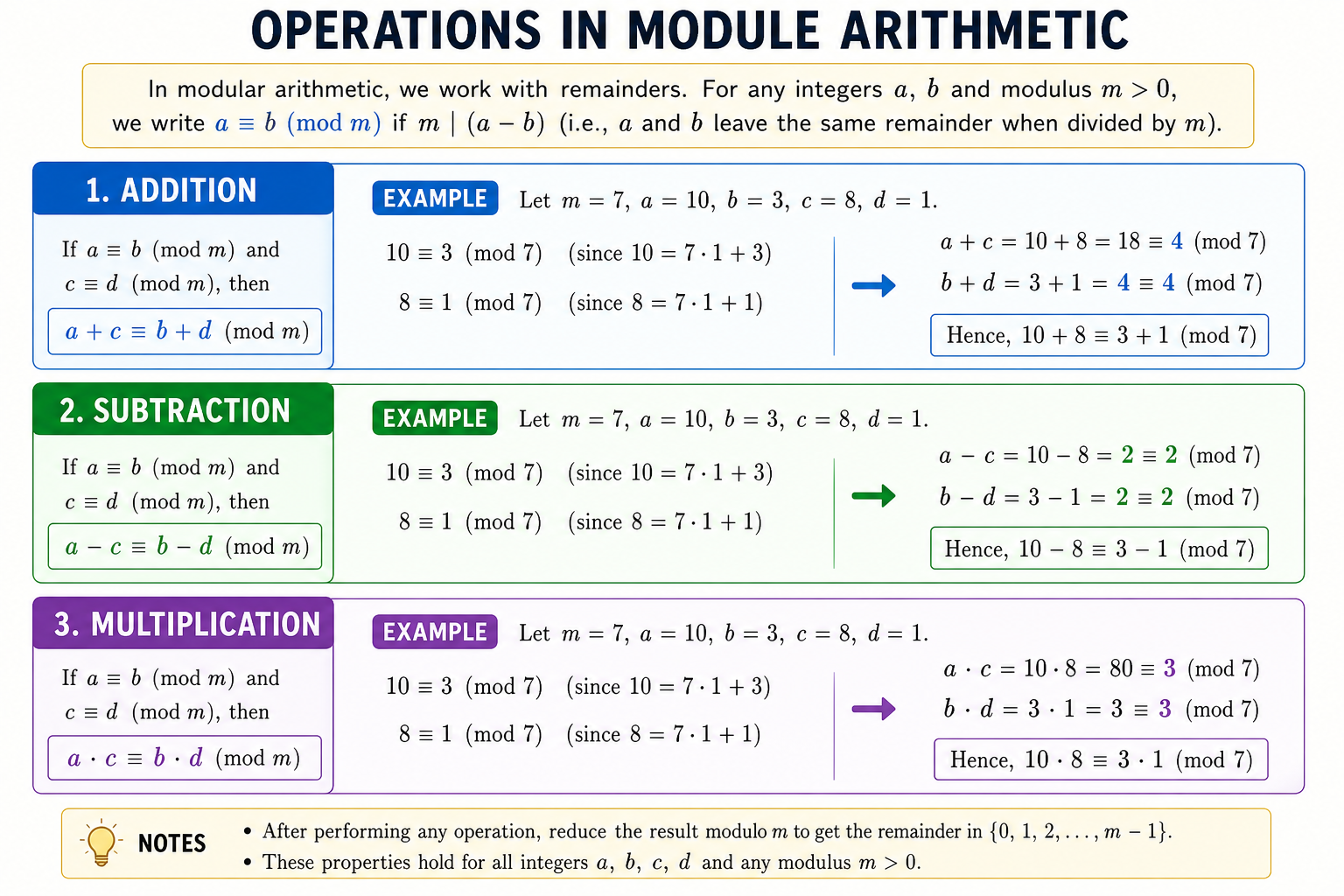
- The Arithmetic of Remainders: Addition, Subtraction, and Multiplication in ℤₙ
- Algebraic Structure: Properties and Patterns
- Applications in Modern Life: Cryptography, Timekeeping, and Error Detection
1. Concept of Modular Arithmetic: The Algebra of Cyclic Systems
The Clock Analogy (Intuitive Introduction)
Imagine a standard 12-hour clock. If it is currently 10 o'clock, what time will it be in 5 hours? Not 15 o'clock, but 3 o'clock. We intuitively "wrap around" after reaching 12. Modular arithmetic formalizes this "wrap-around" behavior for any integer modulus n.
- Congruence (≡): a ≡ b (mod n) denotes a relationship (like equality).
- Modulo Operation (mod): a mod n = r denotes the operation that returns the remainder r when a is divided by n, where 0 ≤ r < n.
Visual Illustration: The Number Circle
Unlike the infinite number line, modular arithmetic operates on a finite cyclic structure:
In this system, moving forward from 11 brings us back to 0. The numbers 0, 1, 2, ..., n-1 form a complete set of residues (remainders).
To reduce a number modulo n, we find its remainder upon division by n.
Reduce 55 modulo 3, 4, 5, and 6:
| Modulus | Division | Remainder | Congruence |
|---|---|---|---|
| 3 | 55 = 18 × 3 + 1 | 1 | 55 ≡ 1 (mod 3) |
| 4 | 55 = 13 × 4 + 3 | 3 | 55 ≡ 3 (mod 4) |
| 5 | 55 = 11 × 5 + 0 | 0 | 55 ≡ 0 (mod 5) |
| 6 | 55 = 9 × 6 + 1 | 1 | 55 ≡ 1 (mod 6) |
2. Arithmetic Operations in ℤₙ
We denote the set of integers modulo n as ℤₙ = {0, 1, 2, ..., n-1}. Operations in this system follow the rule: perform standard arithmetic, then reduce to the least residue.
A. Addition and Subtraction
Addition Table for ℤ₄ (Mod 4)
The symbol ⊕ denotes addition modulo n.
| ⊕ | 0 | 1 | 2 | 3 |
|---|---|---|---|---|
| 0 | 0 | 1 | 2 | 3 |
| 1 | 1 | 2 | 3 | 0 |
| 2 | 2 | 3 | 0 | 1 |
| 3 | 3 | 0 | 1 | 2 |
How to read: 2 ⊕ 3 = 5 ≡ 1 (mod 4). We ignore multiples of 4.
Subtraction as Adding the Inverse
Subtraction a ⊖ b is equivalent to finding x such that b ⊕ x ≡ a (mod n). Graphically, this means moving b steps counter-clockwise on the number circle.
Find 0 ⊖ 3 (mod 4):
- Start at 0 on the clock.
- Move 3 steps backward (counter-clockwise): 0 → 3 → 2 → 1.
- Result: 0 ⊖ 3 ≡ 1 (mod 4).
Find 1 ⊖ 2 (mod 4):
- Start at 1.
- Move 2 steps backward: 1 → 0 → 3.
- Result: 1 ⊖ 2 ≡ 3 (mod 4).
Important Note: Subtraction is not commutative. 2 ⊖ 1 ≡ 1 (mod 4), but 1 ⊖ 2 ≡ 3 (mod 4).
Efficient Calculation Strategy
For large numbers, reduce first, then operate:
Method 1 (Reduce first):
- 39 ≡ 3 (mod 6) (since 39 = 6 × 6 + 3)
- 29 ≡ 5 (mod 6) (since 29 = 6 × 4 + 5)
- 3 ⊕ 5 = 8 ≡ 2 (mod 6)
Method 2 (Add then reduce):
- 39 + 29 = 68
- 68 ÷ 6 = 11 remainder 2
- 68 ≡ 2 (mod 6)
B. Multiplication
Multiplication modulo n is performed by standard multiplication followed by reduction.
Multiplication Table for ℤ₄
| ⊗ | 0 | 1 | 2 | 3 |
|---|---|---|---|---|
| 0 | 0 | 0 | 0 | 0 |
| 1 | 0 | 1 | 2 | 3 |
| 2 | 0 | 2 | 0 | 2 |
| 3 | 0 | 3 | 2 | 1 |
- 2 ⊗ 2 = 4 ≡ 0 (mod 4)
- 3 ⊗ 3 = 9 ≡ 1 (mod 4)
- 33 ⊗ 9 (mod 4):
- Reduce first: 33 ≡ 1 (mod 4) and 9 ≡ 1 (mod 4)
- 1 ⊗ 1 = 1 (mod 4)
Evaluate 16 ⊗ 7 (mod 5):
- 16 ≡ 1 (mod 5) (since 16 = 3 × 5 + 1)
- 7 ≡ 2 (mod 5) (since 7 = 1 × 5 + 2)
- 16 ⊗ 7 ≡ 1 ⊗ 2 = 2 (mod 5)
Evaluate 18 ⊗ 17 (mod 3):
- 18 ≡ 0 (mod 3) (divisible by 3)
- Any number ⊗ 0 ≡ 0
- Therefore, 18 ⊗ 17 ≡ 0 (mod 3)
3. Algebraic Properties of Modular Arithmetic
Modular arithmetic forms a commutative ring with identity. The following properties hold for all a, b, c ∈ ℤₙ:
| Property | Addition | Multiplication |
|---|---|---|
| Closure | a ⊕ b ∈ ℤₙ | a ⊗ b ∈ ℤₙ |
| Commutativity | a ⊕ b = b ⊕ a | a ⊗ b = b ⊗ a |
| Associativity | (a ⊕ b) ⊕ c = a ⊕ (b ⊕ c) | (a ⊗ b) ⊗ c = a ⊗ (b ⊗ c) |
| Identity | a ⊕ 0 = a (0 is identity) | a ⊗ 1 = a (1 is identity) |
| Inverse | Every a has additive inverse -a (or n-a) | Exists only if gcd(a,n)=1 |
4. Applications to Daily Life and Modern Technology
A. Time Calculation (Mod 12 and Mod 24)
- If it is 9:00 AM now, what time is it in 7 hours? 9 + 7 = 16 ≡ 4 (mod 12). Answer: 4:00 PM.
- Determining the day of the week involves arithmetic modulo 7.
B. Rotating Schedules (The Market Example Enhanced)
In many West African communities, markets operate on 4-day or 8-day cycles. If Market A opens today, it will next open in 4 days.
- If today is Day 0, Market A opens on days: 0, 4, 8, 12... ≡ 0 (mod 4)
- Market B (opening tomorrow) opens on days: 1, 5, 9... ≡ 1 (mod 4)
Solution: 45 ÷ 4 = 11 remainder 1, so 45 ≡ 1 (mod 4). No, it is closed; Market B is open.
C. Cryptography: The Caesar Cipher
Julius Caesar encrypted messages by shifting each letter by a fixed number. This is addition modulo 26 (for the alphabet).
- Shift of 3: A → D, B → E, ..., Z → C (since 26 + 3 = 29 ≡ 3 (mod 26), mapping to C if A=1, or adjust indexing).
- Decryption is subtraction modulo 26.
D. Check Digits (Error Detection)
ISBNs, credit cards, and UPC barcodes use modular arithmetic (often mod 10 or mod 11) to detect transcription errors. A weighted sum of digits must satisfy a congruence relation for the number to be valid.
E. Computer Science: Hashing
Hash functions map large data sets to fixed-size indices using modular arithmetic: Index = Hash(data) mod n, ensuring data fits into a table of size n.
Evaluation & Practice Problems
Section A: Computational Skills
1. Reduce to least residue:
- 247 (mod 9)
- -15 (mod 7) (Hint: Add multiples of 7 until positive)
2. Construct the complete addition table for ℤ₅.
3. Evaluate:
- 145 ⊕ 267 (mod 8)
- 20 ⊗ 14 (mod 6)
- 3 ⊖ 7 (mod 5)
Section B: Problem Solving
4. A pharmacist has 100 pills and distributes them into containers holding 6 pills each. Using modular arithmetic, determine how many pills remain after filling as many containers as possible.
5. If your birthday is on a Tuesday this year, what day of the week will it be next year? (Assume non-leap year: 365 days). Use modulo 7.
6. Cryptography Challenge: Decode the message "KHOOR" knowing it was encrypted with a Caesar shift of +3 (i.e., x → x+3 (mod 26)).
Section C: Conceptual Understanding
7. Explain why division is not always possible in modular arithmetic. For example, why does 2 ÷ 3 (mod 6) have no solution?
8. Identify which elements in ℤ₆ have multiplicative inverses. What pattern do you notice regarding the relationship between these numbers and the modulus 6?
Test yourself on Mathematics
Track your reading & take quizzes
Create free account