Number Bases Conversion II
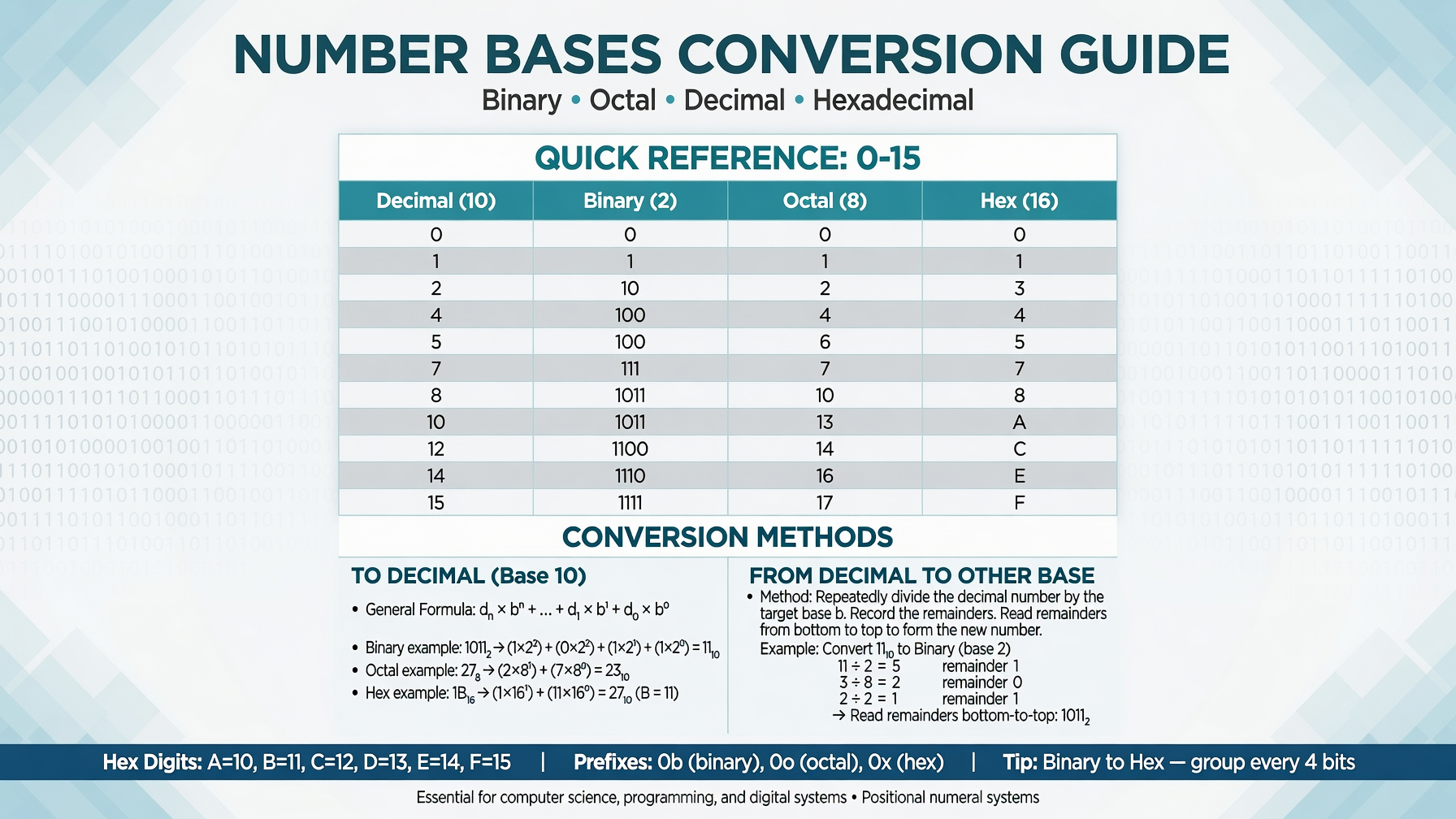
Binary Numbers (Base 2)
Rephrased, updated, and expanded notes with clear illustrations and worked examples.
Introduction to Binary Numbers
Binary numbers are numbers written using only two digits: 0 and 1. This is why binary is called base 2.
Binary digits are also called bits.
Place Value in Binary
Just as decimal numbers use powers of 10, binary numbers use powers of 2.
| Place value | 25 | 24 | 23 | 22 | 21 | 20 |
|---|---|---|---|---|---|---|
| Value | 32 | 16 | 8 | 4 | 2 | 1 |
Convert 1011012 to decimal:
101101₂ = 1(32) + 0(16) + 1(8) + 1(4) + 0(2) + 1(1)
         = 32 + 8 + 4 + 1
         = 45₁₀
Addition in Base 2
Binary addition is done in the same column-by-column way as decimal addition. The difference is that only two digits are used, so carrying happens more often.
Basic Addition Rules
| Binary Sum | Meaning |
|---|---|
| 0 + 0 = 0 | No carry |
| 0 + 1 = 1 | No carry |
| 1 + 0 = 1 | No carry |
| 1 + 1 = 102 | Write 0 and carry 1 |
| 1 + 1 + 1 = 112 | Write 1 and carry 1 |
| 1 + 1 + 1 + 1 = 1002 | Write 0, carry 102 |
Worked Examples
Simplify:
  1110₂
+ 1001₂
-------
 10111₂
Answer: 1110₂ + 1001₂ = 10111₂
Simplify:
   1111₂
 + 1101₂
 + 0101₂
--------
 100001₂
Answer: 1111₂ + 1101₂ + 101₂ = 100001₂
Simplify:
11011₂ + 1111₂ = 101010₂
Check in decimal: 27 + 15 = 42, and 42 in binary is 101010₂.
Simplify:
10011₂ + 1110₂ = 100001₂
Check in decimal: 19 + 14 = 33, and 33 in binary is 100001₂.
Simplify:
110111₂ + 11011₂ + 10111₂ = 1101001₂
Check in decimal: 55 + 27 + 23 = 105, and 105 in binary is 1101001₂.
Evaluation / Practice
- Simplify 1001₂ + 101₂ + 1111₂
- Simplify 10101₂ + 111₂
Subtraction in Base 2
Binary subtraction is also performed column by column. If the top digit is smaller than the bottom digit, you must borrow from the next column on the left.
Basic Subtraction Rules
| Binary Difference | Meaning |
|---|---|
| 0 - 0 = 0 | No borrowing needed |
| 1 - 0 = 1 | No borrowing needed |
| 102 - 12 = 12 | Borrowing example |
| 112 - 12 = 102 | Borrowing example |
| 1002 - 12 = 112 | Borrowing example |
Worked Examples
Simplify:
 1110₂
-1001₂
------
 0101₂
Answer: 1110₂ - 1001₂ = 101₂
Simplify:
 101010₂
-   111₂
--------
 100011₂
Answer: 101010₂ - 111₂ = 100011₂
Simplify:
1001₂ - 111₂ = 10₂
Check in decimal: 9 - 7 = 2, and 2 in binary is 10₂.
Simplify:
10001₂ - 1111₂ = 10₂
Check in decimal: 17 - 15 = 2.
Simplify:
11010₂ - 1111₂ = 1011₂
Check in decimal: 26 - 15 = 11, and 11 in binary is 1011₂.
Evaluation / Practice
- Simplify 10110₂ - 101₂
- Simplify 11100₂ - 1101₂
Multiplication and Division in Base 2
Multiplication in Binary
Binary multiplication uses the same long multiplication method as decimal multiplication. The product of each digit follows these rules:
| Multiplication | Result |
|---|---|
| 0 × 0 | 0 |
| 0 × 1 | 0 |
| 1 × 0 | 0 |
| 1 × 1 | 1 |
Worked Examples
Simplify:
   1110₂
×   111₂
--------
   1110
  11100
 111000
--------
1100010₂
Answer: 1110₂ × 111₂ = 1100010₂
Simplify:
101011₂ × 110₂ = 100000010₂
Check in decimal: 43 × 6 = 258.
Simplify:
11101₂ × 111₂ = 11001011₂
Check in decimal: 29 × 7 = 203.
Division in Binary
Binary division is the reverse of multiplication. It can be done using long division or repeated subtraction. At each step, decide whether the divisor fits into the current part of the dividend.
Worked Examples
Simplify:
101010₂ ÷ 111₂ = 110₂
Check in decimal: 42 ÷ 7 = 6.
Divide 1010.01₂ by 11₂, correct to 3 binary places.
1010.01₂ ÷ 11₂ ≈ 11.011₂
The decimal check is 10.25 ÷ 3 = 3.41666..., which matches the binary approximation 11.011₂.
Quick Summary
- Addition: Add from right to left; use carries when a column total reaches 2 or more.
- Subtraction: Subtract from right to left; borrow when the top digit is smaller.
- Multiplication: Use long multiplication and shifting.
- Division: Use long division or repeated subtraction.
Test yourself on Mathematics
Track your reading & take quizzes
Create free account