Number Bases Conversion I
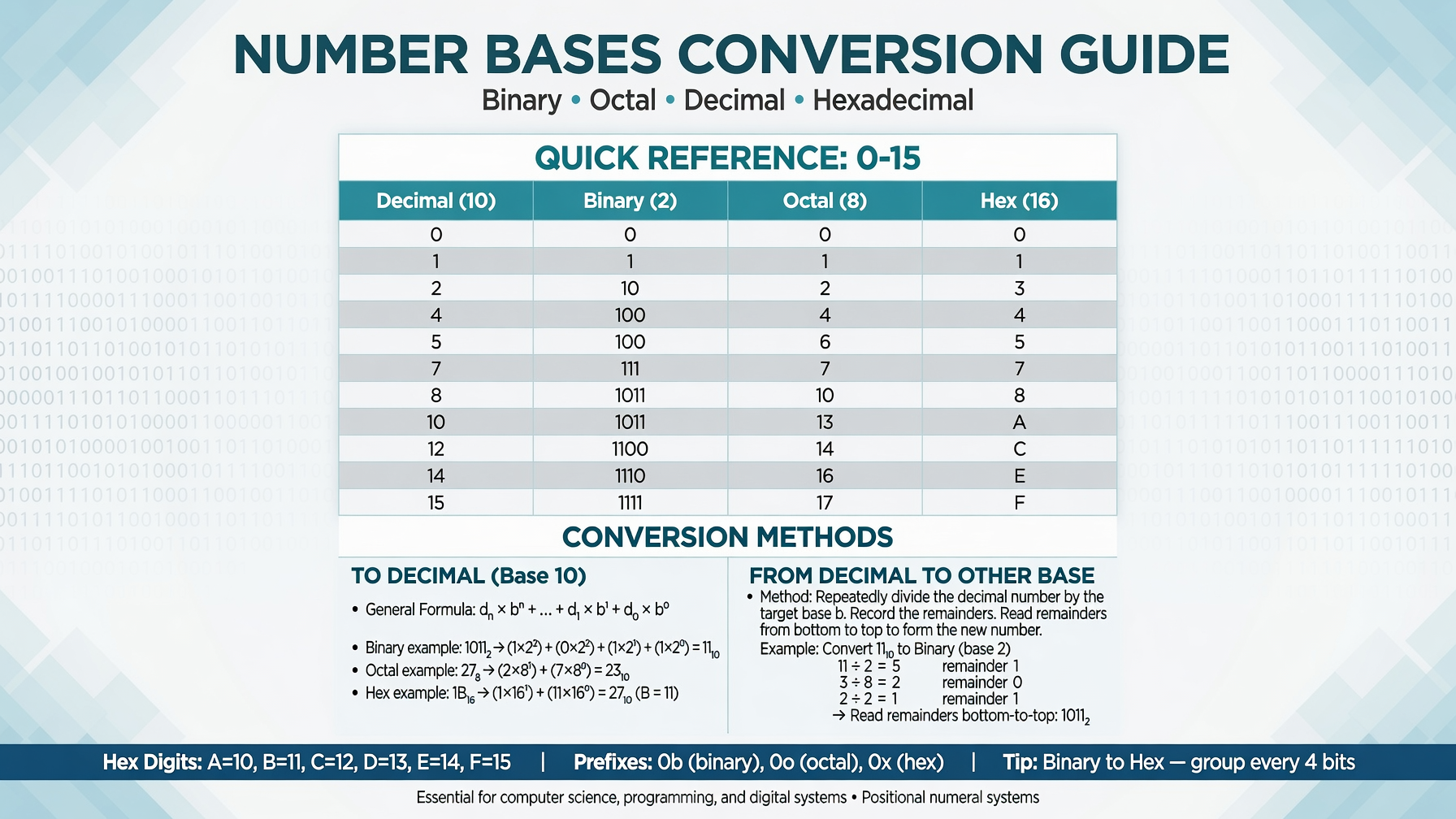
NUMBER BASE CONVERSIONS
1. Introduction
In everyday life, people usually count in base ten because we use the ten digits: 0, 1, 2, 3, 4, 5, 6, 7, 8, 9.
However, other number systems are also used:
- Base 2 (binary) – used in computers
- Base 8 (octal) – sometimes used in computing
- Base 16 (hexadecimal) – common in programming and digital electronics
- Some traditional counting systems also used base 5 or base 20
- Time has mixed-base ideas too:
- 60 seconds = 1 minute
- 60 minutes = 1 hour
- 24 hours = 1 day
A base (or radix) tells us how many different digits are available in a number system.
2. Meaning of a Base
In any base:
- the smallest digit is 0
- the largest digit is base − 1
| Base | Name | Allowed digits |
|---|---|---|
| 2 | Binary | 0, 1 |
| 5 | Quinary | 0, 1, 2, 3, 4 |
| 8 | Octal | 0, 1, 2, 3, 4, 5, 6, 7 |
| 10 | Decimal / Denary | 0, 1, 2, 3, 4, 5, 6, 7, 8, 9 |
| 16 | Hexadecimal | 0–9, A, B, C, D, E, F |
In base 16:
- A = 10
- B = 11
- C = 12
- D = 13
- E = 14
- F = 15
Important notation: A number such as (27)8 means 27 in base 8.
3. Place Value in Any Base
The value of a digit depends on its position.
Example 1: Base Ten
Consider the decimal number (395)10.
| Digit | Place value | Contribution |
|---|---|---|
| 3 | 102 | 3 × 100 = 300 |
| 9 | 101 | 9 × 10 = 90 |
| 5 | 100 | 5 × 1 = 5 |
Example 2: (4075)10
| Digit | Place value | Contribution |
|---|---|---|
| 4 | 103 | 4 × 1000 = 4000 |
| 0 | 102 | 0 × 100 = 0 |
| 7 | 101 | 7 × 10 = 70 |
| 5 | 100 | 5 × 1 = 5 |
4. Expansion of Numbers in Other Bases
Numbers in other bases are expanded using powers of their base.
Example 1: Expand (647)8
Example 2: Expand (26523)7
Example 3: Expand (101101)2
Evaluation
Expand the following:
- (735)8
- (1010011)2
5. Conversion to Decimal (Base Ten)
To convert a number from another base to base ten:
- Multiply each digit by the appropriate power of the base.
- Add the results.
Example 1: Convert (27)8 to base 10
Example 2: Convert (11011)2 to base 10
Evaluation
Convert the following to base ten:
- (101011)2
- (2120)3
6. Conversion from Base Ten to Other Bases
To convert a decimal number to another base:
- Divide the decimal number by the new base.
- Write down the remainder.
- Divide the quotient again by the new base.
- Continue until the quotient becomes zero.
- Read the remainders from bottom to top.
Example 1: Convert (68)10 to base 5
| Division | Quotient | Remainder |
|---|---|---|
| 68 ÷ 5 | 13 | 3 |
| 13 ÷ 5 | 2 | 3 |
| 2 ÷ 5 | 0 | 2 |
Check:
Example 2: Convert (129)10 to base 2
| Division | Quotient | Remainder |
|---|---|---|
| 129 ÷ 2 | 64 | 1 |
| 64 ÷ 2 | 32 | 0 |
| 32 ÷ 2 | 16 | 0 |
| 16 ÷ 2 | 8 | 0 |
| 8 ÷ 2 | 4 | 0 |
| 4 ÷ 2 | 2 | 0 |
| 2 ÷ 2 | 1 | 0 |
| 1 ÷ 2 | 0 | 1 |
Evaluation
Convert:
- (568)10 to base 8
- (100)10 to base 2
7. Fractions in Other Bases
Digits to the right of the point represent negative powers of the base.
Base Ten Fractions
8. Binary Fractions (Bicimals)
A binary fraction uses powers of 2, including negative powers.
Illustration
| Left of point | Right of point |
|---|---|
| 20 | 2-1, 2-2, 2-3, ... |
- 2-1 = 1/2
- 2-2 = 1/4
- 2-3 = 1/8
9. Converting Binary Fractions to Decimal
Example 1: Convert (1.101)2 to decimal
Example 2: Convert (10.011)2 to decimal
Example 3: Convert (110.11)2 to decimal
Evaluation
Convert the following binary fractions to base ten:
- (10.0001)2
- (10.01)2
- (11.1)2
- (0.001)2
10. Converting from One Base to Another Base
A number in one base can be converted to another base in two main ways:
- Through base ten: Convert first to decimal, then from decimal to the new base.
- Direct conversion: Used especially between base 2, base 8, and base 16.
Example 1: Convert (1534)6 to base 8
Step 1: Convert (1534)6 to base 10
Step 2: Convert (418)10 to base 8
| Division | Quotient | Remainder |
|---|---|---|
| 418 ÷ 8 | 52 | 2 |
| 52 ÷ 8 | 6 | 4 |
| 6 ÷ 8 | 0 | 6 |
Example 2: Convert (8A9F)16 to base 8
Step 1: Convert to base 10
Step 2: Convert (35487)10 to base 8
| Division | Quotient | Remainder |
|---|---|---|
| 35487 ÷ 8 | 4435 | 7 |
| 4435 ÷ 8 | 554 | 3 |
| 554 ÷ 8 | 69 | 2 |
| 69 ÷ 8 | 8 | 5 |
| 8 ÷ 8 | 1 | 0 |
| 1 ÷ 8 | 0 | 1 |
11. Useful Shortcut: Direct Conversion Between Base 2, 8, and 16
Because:
- 8 = 23
- 16 = 24
we can convert through binary quickly.
Example: Convert (8A9F)16 to base 8
Convert each hexadecimal digit to 4 binary digits:
- 8 = 1000
- A = 1010
- 9 = 1001
- F = 1111
Group into sets of 3 from the right:
Convert each group to octal:
- 001 = 1
- 000 = 0
- 101 = 5
- 010 = 2
- 011 = 3
- 111 = 7
12. Finding Unknown Bases
Sometimes the base is not given and must be found.
Example
Determine the bases x and y in:
Step 1: Convert each number to algebraic form
Step 2: Solve the simultaneous equations
13. Common Mistakes to Avoid
- Using an invalid digit
Example: (278)8 is invalid because 8 is not allowed in base 8. - Forgetting that powers start at zero
The rightmost whole-number digit is always multiplied by base0. - Reading remainders in the wrong direction
In repeated division, read from bottom to top. - Ignoring zero as a placeholder
In (4075)10, the zero still has meaning. - For fractions, forgetting negative powers
Example: in (1.101)2, the digits after the point are 2-1, 2-2, 2-3.
14. Short Summary
- A base tells how many digits a number system uses.
- In base b, place values are powers of b.
- To convert to decimal, expand using powers of the base.
- To convert from decimal, use repeated division.
- For fractions, use negative powers of the base.
- For bases 2, 8, and 16, direct conversion is often faster.
15. Practice Answers
Expansion
Convert to base ten
Convert from base ten
Binary fractions
End of Note: Number Base Conversions
Test yourself on Mathematics
Track your reading & take quizzes
Create free account